

 ChatGPT
 Perplexity
 Google AI
 Claude

EIFS and traditional stucco may look similar from the street, but they function very differently. EIFS is an engineered insulated exterior wall system built to control energy transfer and manage incidental moisture through a drainage layer. Traditional stucco is a cement-based system known for structural durability, breathability, and long-term resilience.
For residential and commercial properties in NYC, the right choice depends on insulation priorities, moisture control strategy, building type, and long-term maintenance planning. This guide explains how each system works, where each performs best, and which may be the smarter investment for your property.
- Ο EIFS integrates exterior insulation with a managed drainage layer for improved envelope performance.
- Ο Traditional stucco provides a rigid cement-based exterior finish valued for durability and breathability.
- Ο EIFS reduces thermal bridging through continuous exterior insulation.
- Ο Stucco performs reliably on masonry structures requiring impact resistance.
- Ο Proper installation determines long-term performance for both systems.
- Ο In NYC’s climate, moisture control and freeze-thaw tolerance are critical selection factors.
What Is Traditional Stucco?
Traditional stucco is a cement-based exterior rendering system applied directly over masonry or metal lath. It consists of Portland cement, sand, lime, and water, forming a dense, rigid exterior shell once fully cured. Unlike integrated insulated cladding systems, stucco relies on material mass and breathability rather than integrated insulation layers.
How the System Is Built
In most professional installations, stucco is applied as a three-coat system:
- Scratch Coat – bonds the material to the substrate
- Brown Coat – builds thickness and structural integrity
- Finish Coat – provides texture and weather resistance
When properly installed and cured, the system creates a hard protective layer capable of withstanding impact and surface wear.
Structural Performance & Durability
Stucco performs well in structures that benefit from vapor permeability, allowing incidental moisture to escape instead of becoming trapped. In climates like NYC, where seasonal freeze-thaw cycles occur, properly detailed stucco can remain stable for decades when expansion joints and flashing are correctly installed.
For masonry buildings, historic properties, and solid wall assemblies, traditional stucco remains a dependable exterior finish due to its rigidity and long service life.
What Is EIFS?
EIFS, or Exterior Insulation and Finish System, is a multi-layered synthetic cladding system engineered to deliver exterior insulation with an integrated finished surface. Unlike cement-based stucco, EIFS is designed as an integrated wall assembly rather than a rigid outer coating.
Core Components of an EIFS Assembly
A professionally installed EIFS system typically includes:
- Insulation Board – mechanically or adhesively attached to the substrate to create a continuous insulation layer.
- Base Coat with Reinforcing Mesh – adds impact resistance and distributes surface stress.
- Finish Coat – an acrylic-based textured coating that provides color and weather protection.
- Drainage Plane (Modern Systems) – channels incidental moisture downward and out of the wall assembly.
Earlier barrier-type EIFS relied primarily on exterior sealing, while modern drainage EIFS systems are specifically designed to manage water intrusion more effectively.
System Behavior in the Field
Because EIFS is lightweight and slightly flexible, it can accommodate minor substrate movement better than rigid cement systems. The integrated insulation layer reduces direct thermal transfer through wall framing, while the reinforced base coat protects against surface cracking when properly installed.
EIFS is often specified for commercial buildings, contemporary residential construction, and projects where energy performance and design flexibility are priorities.
EIFS vs. Stucco: Structural & Performance Differences
While both systems serve as exterior finishes, their structural behavior and long-term performance differ significantly. As explained in our guide on synthetic stucco vs traditional stucco, the real distinction becomes clear when evaluating how each responds to movement, moisture exposure, surface impact, and installation precision.
Below is a side-by-side comparison of how the two systems perform under structural and field conditions:
| Performance Factor | Traditional Stucco | EIFS |
|---|---|---|
| System Type | Rigid cement-based wall system | Layered insulated cladding system |
| Structural Behavior | Rigid, impact-resistant surface | Reinforced but slightly flexible surface |
| Substrate Movement Tolerance | Limited; may develop hairline cracks if stress occurs | Accommodates minor structural movement |
| Moisture Management | Vapor permeable; depends on proper flashing and drainage detailing | Integrated drainage layer in modern systems |
| Assembly Weight | Heavy, solid mass | Lightweight composite system |
| Installation Sensitivity | Requires correct curing and expansion joints | Requires precise flashing, sealing, and detailing |
| Typical Application | Masonry and solid wall assemblies | Framed construction requiring exterior insulation |
From a structural perspective, stucco functions as a rigid protective shell designed for durability and impact resistance. EIFS operates as a controlled wall system where insulation, reinforcement mesh, and drainage components work together to manage energy transfer and moisture exposure.
Selection should be based on wall assembly design, structural movement expectations, and long-term performance demands, not surface appearance alone.
Pros & Cons: EIFS vs. Stucco
Both systems perform reliably when installed correctly, but their advantages and limitations influence long-term performance, energy efficiency, and maintenance expectations.
| System | Key Advantages | Practical Limitations |
|---|---|---|
| Traditional Stucco | Long service life with proper maintenance | Limited inherent insulation value |
| Strong impact resistance | May develop hairline cracking over time | |
| Naturally fire-resistant | Heavier system requiring solid substrate | |
| Well-suited for masonry and historic properties | Repairs may require finish blending | |
| EIFS | Continuous exterior insulation improves efficiency | Installation precision is critical |
| Lightweight and adaptable to framed construction | Poor detailing can lead to moisture intrusion | |
| Wide range of textures and finishes | Higher initial installation cost | |
| Integrated drainage layers manage incidental moisture | Impact resistance varies by reinforcement type |
Stucco emphasizes structural rigidity and impact durability, while EIFS emphasizes insulation continuity and controlled moisture management. The appropriate choice depends on wall assembly type, climate exposure, and long-term performance goals.
EIFS vs. Stucco: Thermal Performance & Energy Efficiency
Thermal performance is one of the clearest functional differences between EIFS and traditional stucco. While both serve as exterior finishes, only one actively contributes to building insulation performance.
Traditional stucco is a cement-based render with negligible inherent R-value. Its thermal behavior depends almost entirely on the insulation installed within the wall cavity behind it. The stucco layer provides durability and weather protection, but does not significantly improve insulation performance.
EIFS is engineered as an insulated cladding system. The insulation board installed on the exterior wall creates continuous thermal coverage, which helps reduce thermal bridging at framing members. This design improves overall envelope efficiency and stabilizes indoor temperature fluctuations.
Why This Matters in Real-World Conditions
- Continuous exterior insulation reduces heat loss through wall studs.
- Improved thermal consistency lowers stress on HVAC systems.
- Exterior insulation placement helps prevent cold spots and condensation risk.
- Stucco-based systems rely on interior wall insulation for performance outcomes.
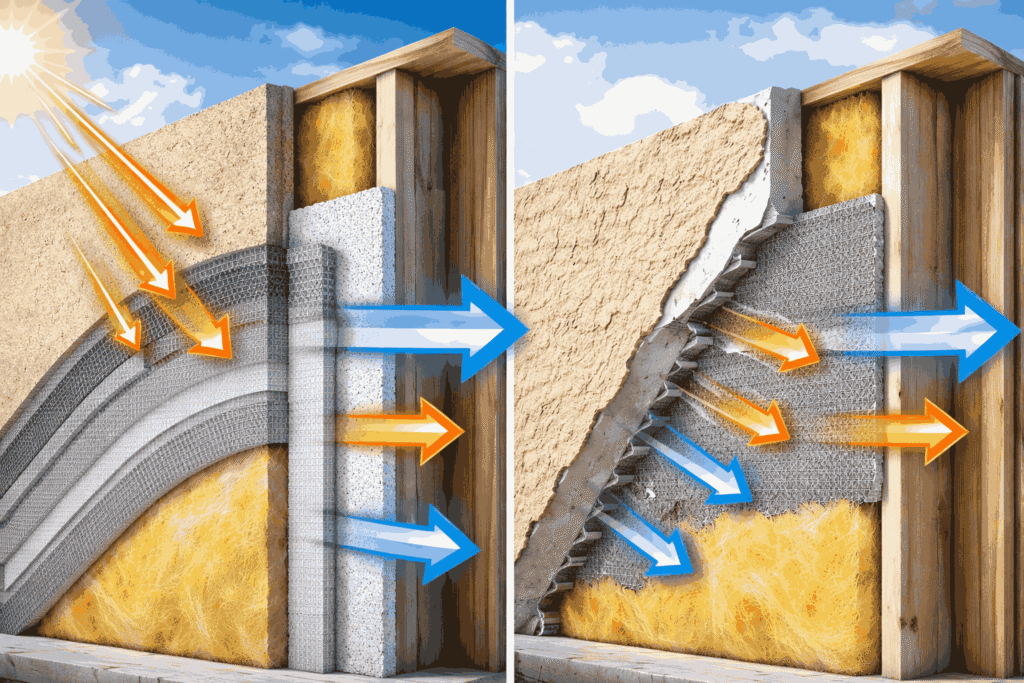
In climates with seasonal temperature variation, wall assemblies with continuous exterior insulation typically outperform those without it. EIFS offers this as an integrated feature, while stucco performance depends on the overall wall assembly design.
EIFS vs. Stucco: Moisture Management & Water Control
Moisture performance is a primary deciding factor between EIFS and traditional stucco. Exterior wall systems rarely fail from surface wear; they fail when water enters and cannot properly exit.
Traditional stucco is vapor-permeable, meaning it allows incidental moisture within the wall assembly to evaporate outward. However, it does not contain a built-in drainage cavity. Its success depends heavily on proper flashing, weep screeds, control joints, and substrate preparation. When these details are executed correctly, stucco assemblies can perform reliably for decades. However, routine inspection remains essential, particularly in regions exposed to freeze-thaw cycles when evaluating signs of hidden stucco damage after winter exposure.
Modern EIFS systems are designed with a dedicated drainage plane behind the insulation board. This allows water that penetrates the outer surface to move downward and exit through designated pathways. Earlier barrier-type EIFS relied primarily on exterior sealants, but contemporary drainage EIFS assemblies are engineered specifically to manage incidental moisture.
Risk Profile Differences
Instead of focusing on surface appearance, professionals evaluate how each system handles water intrusion scenarios:
- Stucco relies on breathable mass and proper detailing to prevent trapped moisture.
- EIFS relies on controlled drainage and correct flashing integration.
- Improper installation is the primary cause of moisture-related failures in both systems.
- Wall penetrations, window transitions, and roof-to-wall intersections are critical control points.
In regions exposed to driving rain, humidity, and seasonal freeze-thaw cycles, moisture detailing becomes more important than surface material selection alone. Long-term performance depends more on installation quality and water management strategy than on the cladding material alone.
EIFS vs. Stucco: Installation Complexity & Common Failure Points
Material performance is only part of the equation. Long-term success depends heavily on installation accuracy, sequencing, and detailing discipline.
Traditional stucco installation requires proper substrate preparation, correct lath attachment, expansion joint placement, and adequate curing time between coats. Rushing the curing process or neglecting control joints often leads to premature cracking and stress fractures, especially in colder climates, where understanding why cold weather accelerates stucco cracking becomes critical to preventing premature failure.
EIFS installation involves precise layering, adhesive application, reinforcement mesh embedding, and detailed integration around windows, penetrations, and roof transitions. Because EIFS functions as a system rather than a single material layer, incorrect flashing or sealant transitions can compromise overall performance.
Where Installation Errors Typically Occur
In field inspections, failure points are almost always linked to detailing errors rather than the cladding material itself.
For Stucco
- Inadequate control joints across large wall areas
- Insufficient curing time between application coats
- Improper lath fastening or substrate preparation
For EIFS
- Incorrect drainage plane integration
- Weak detailing around windows and penetrations
- Inconsistent mesh reinforcement in high-impact zones
Neither system is inherently problematic when installed by experienced professionals. Failures typically result from workmanship gaps, improper sequencing, or inadequate supervision during critical envelope detailing stages.
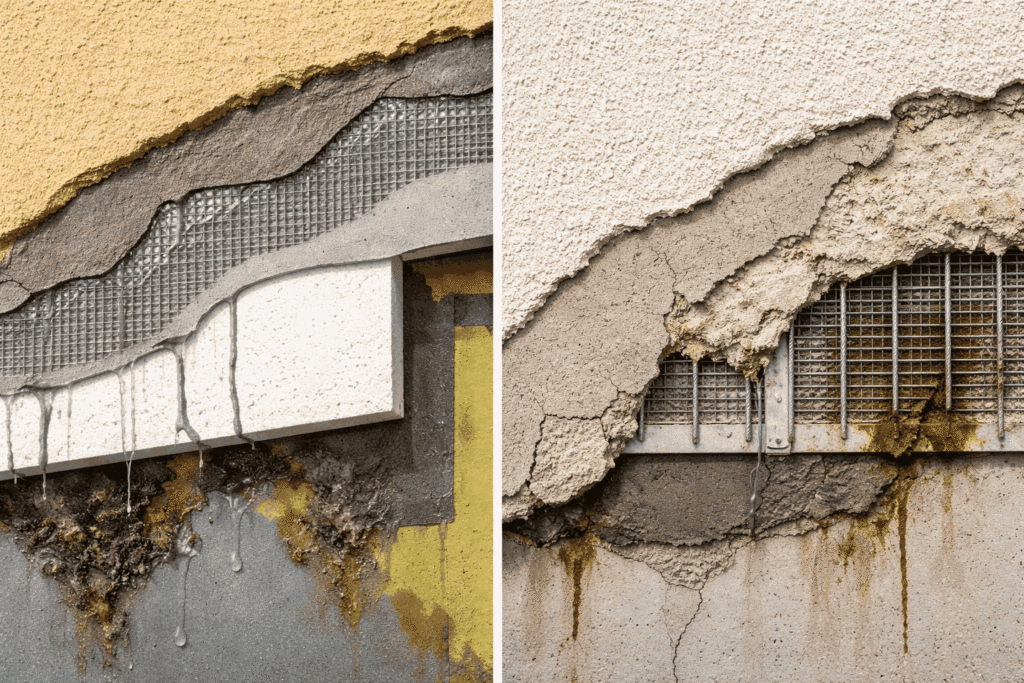
For property owners, contractor experience and envelope detailing expertise often influence long-term performance more than the cladding material itself.
EIFS vs. Stucco: Cost Comparison & Long-Term Value
Initial pricing alone does not determine overall value. Exterior cladding decisions should be evaluated based on installation cost, maintenance exposure, energy impact, and expected service life.
Traditional stucco generally carries a lower material cost at the outset, particularly on masonry substrates where minimal structural modification is required. Labor costs may increase depending on surface preparation, scaffold access, and detailing complexity, but the system itself is straightforward and widely understood.
EIFS typically involves higher upfront installation costs due to system components, insulation boards, reinforcement mesh, and precision detailing requirements. However, because EIFS integrates exterior insulation, it may reduce long-term operational costs.
| Cost Factor | Traditional Stucco | EIFS |
|---|---|---|
| Initial Material Cost | Moderate | Higher |
| Installation Labor | Skilled masonry labor | Specialized system installation |
| Energy Performance Impact | Dependent on wall insulation | Integrated exterior insulation |
| Maintenance Sensitivity | Surface cracking repair | Sealant and detailing inspection |
| Long-Term Value Driver | Durability and longevity | Energy efficiency and insulation continuity |
For masonry-heavy buildings where durability and impact resistance are primary concerns, stucco may present a cost-efficient solution over time. For framed structures prioritizing energy efficiency and envelope performance, EIFS may provide measurable operational advantages despite higher initial investment.
The more appropriate system is determined not by upfront pricing alone, but by building type, insulation goals, and long-term maintenance planning.
Final Verdict: Which System Should You Choose?
There is no universally superior system. The right choice depends on building structure, performance priorities, and long-term property goals.
Choose Traditional Stucco If:
- Your building has a masonry or solid wall assembly
- Surface durability and impact resistance are primary concerns
- You are working with historic or classic architectural designs
- You prefer a rigid cement-based exterior finish
- Energy insulation is already addressed within the wall system
Choose EIFS If:
- The structure is a wood or steel-framed construction
- Exterior continuous insulation is a priority
- Energy performance and envelope efficiency are key objectives
- You want greater flexibility in finish textures and detailing
- The project benefits from a lighter cladding system
In practice, the decision should align with how the wall assembly is built and how the building will perform over decades, not just how it looks upon completion. A properly selected and professionally installed system will always outperform a mismatched material applied to the wrong structure.

For residential and commercial properties across NYC, system selection should also account for local climate exposure, maintenance planning, and contractor expertise.
Professional Exterior Cladding Services in NYC
Choosing between EIFS and traditional stucco requires more than surface comparison; it demands a clear understanding of wall assemblies, moisture detailing, structural behavior, and long-term envelope performance. System selection should align with building type, climate exposure, and proper detailing to ensure durability and code compliance.
Sardar Restoration Corp provides EIFS and stucco installation, repair, and restoration services for residential and commercial properties across NYC, including The Bronx, Manhattan, Brooklyn, Westchester, and Queens. Each project is evaluated based on substrate condition, drainage detailing, and long-term performance planning to deliver reliable, structurally sound results tailored to the property’s specific construction requirements.
For a professional assessment of your exterior system, call (+1) 917-355-8556, email sardarrestoration@gmail.com, or visit 2770 Fish Ave, Bronx, NY 10469, United States.
FAQs
Is EIFS better than traditional stucco?
EIFS is better for projects prioritizing continuous exterior insulation and energy efficiency, while traditional stucco is better suited for masonry structures requiring durability and impact resistance.
Does EIFS crack like stucco?
EIFS is more flexible than cement-based stucco, so it is less prone to structural cracking, but improper installation can still lead to surface damage.
Which lasts longer, EIFS or stucco?
Both systems can last decades when properly installed and maintained; longevity depends more on detailing and maintenance than on material type alone.
Is stucco more water-resistant than EIFS?
Stucco is vapor-permeable and relies on proper flashing for drainage, while modern EIFS systems include a dedicated drainage layer to manage incidental moisture. In colder climates, proper detailing and freeze-thaw weatherproofing preparation are critical to long-term performance.
Is EIFS more expensive than stucco?
EIFS generally has a higher upfront installation cost, but long-term value may vary depending on energy performance and maintenance planning.
Can EIFS be installed over existing stucco?
In some cases, EIFS can be installed over properly prepared surfaces, but a professional inspection is required to assess substrate condition and compatibility. Seasonal conditions also matter, especially when evaluating whether stucco can be applied during winter temperatures.
Is EIFS fire-resistant like stucco?
Traditional stucco is naturally fire-resistant due to its cement composition, while EIFS systems are engineered to meet fire safety standards when installed according to code requirements.
Which system performs better in NYC’s climate?
Performance depends on wall assembly and detailing; stucco offers durable surface protection, while EIFS provides insulation continuity that can benefit buildings exposed to seasonal temperature shifts.