EIFS Installation Queens
EIFS installation on Queens houses. Nearly all of it is retrofit work, which means going onto a wall that already has siding on it, around windows that are staying where they are, and up to a neighbor who is not recladding.
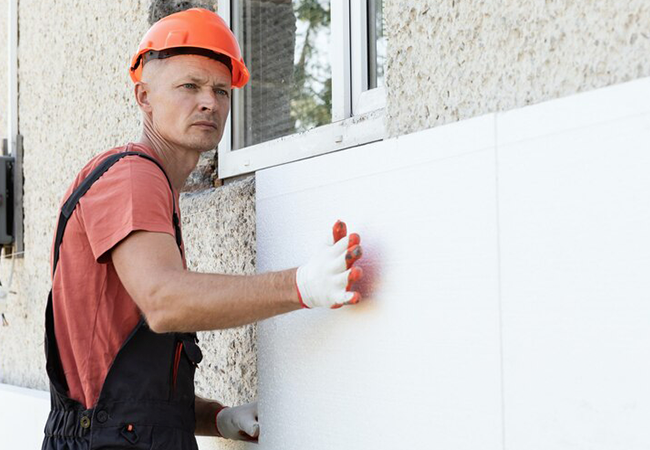

EIFS installation on Queens houses. Nearly all of it is retrofit work, which means going onto a wall that already has siding on it, around windows that are staying where they are, and up to a neighbor who is not recladding.

Most EIFS in Queens goes onto an existing house rather than onto new construction. That changes the job. On a new wall the sequence is straightforward and everything is detailed before the windows go in. On a retrofit, the windows are already there, something is already on the wall, and the house next door is attached.
Those three constraints decide most of the cost and nearly all of the risk. We work through them before quoting rather than after, because the answer to what is behind the siding changes whether this is a straightforward re-clad or a much larger job.
Four things are true on a Queens house that are not true on a new commercial wall.
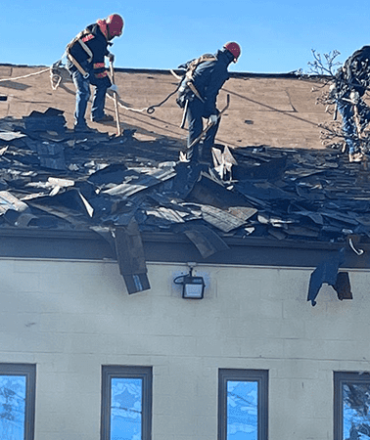
Vinyl, aluminum, old stucco or brick veneer. Whether it comes off or gets built over is the first decision on a Queens retrofit, and it moves the price more than any other choice.
Most Queens houses have had their windows replaced at least once, and you cannot properly flash an opening you are not removing. The detail gets worked around what is there rather than integrated behind it.
On a semi-detached Queens house with a narrow side yard, that build-up matters at the lot line. It also changes the reveal at every opening and the roof edge.
On an attached or semi-attached Queens house the new EIFS stops at the party line while the other house stays where it is. That junction has to be detailed, not just ended.
A section comes off before any EIFS is quoted. On a Queens two-family from the 1920s or 30s there is often no insulation at all behind the siding, and sometimes water that has been sitting there for years.
Before the EIFS board goes up, the water-resistive barrier is tied into the existing window and door details as far as it can be without pulling the units. Where that cannot be done properly, we say so rather than cover it.
EIFS board, base coat with mesh, then the finish. On the attached rows through Ozone Park and Woodhaven the party line termination is detailed last, and it is where the work gets judged.

On a retrofit, a number on its own tells you very little. An estimate worth comparing separates the removal of the existing siding from the new work, says what happens if the sheathing underneath turns out to be wet, states whether any windows are coming out, and prices the party line detail rather than leaving it as an assumption. Ours does. If another quote does not, those are the four things to ask about before you decide on price.
Retrofit work concentrates where the frame houses are, through Ozone Park, Richmond Hill and Woodhaven, and on the newer stock out toward Whitestone and Bayside.
See stucco contractor Queens for the rest of our stucco work in the borough, or EIFS installation NYC for the system specification and the code requirements on taller buildings.

Browse our gallery to explore the outstanding projects we’ve successfully completed, highlighting our expertise.
Usually yes. A lot of Queens houses were re-sided in vinyl through the 1980s and 90s, and vinyl is neither flat enough nor strong enough to take EIFS. Taking it off also lets us see the sheathing, which decides whether this is a straightforward job or a much bigger one.
Sometimes, and it is worth knowing early. Flashing works best when it is tucked behind the window flange, which is only possible if the unit is out. On a retrofit we usually detail around the existing window instead. Where that will not perform, we will tell you rather than cover it.
Different trade-offs. EIFS adds real continuous insulation and gives a solid masonry-like finish, and it costs considerably more. Vinyl is cheaper and faster and adds almost no insulation. If the wall has no insulation and you want the look of stucco, EIFS wins. If neither of those matters, it probably does not.
It does not stop the job, but the party line needs detailing. On the attached rows through Richmond Hill and South Ozone Park your wall ends up around three inches proud of the neighbor’s, so that edge has to be closed properly rather than just stopped.
It depends on the finish and the street. On a block of mixed siding it disappears. On an unbroken run of matching brick two-families through Maspeth or Middle Village it will read as different however it is finished. We will show you completed work nearby and give you an honest view first.