
 ChatGPT
 Perplexity
 Google AI
 Claude
Lintels quietly support the masonry above windows and doors, but in NYC homes, their role becomes critical due to heavy construction loads, aging structures, and constant exposure to harsh weather cycles. From brownstones in Manhattan, townhouses across the Bronx, mixed-use buildings in Brooklyn, historic properties in Queens, to residential structures in Yonkers and Westchester, lintels help prevent cracking, sagging, and long-term structural damage. Steel and stone lintels remain the most common choices across these areas, each responding differently to structural stress, moisture exposure, and architectural demands.
A lintel that performs well in a modern Brooklyn renovation may not be suitable for a landmarked Manhattan property or an older masonry building in the Bronx. This guide explains how steel and stone lintels behave under real NYC conditions so homeowners, landlords, and property managers can make informed decisions for both residential and commercial properties.
Quick Overview
Steel and stone lintels both support masonry openings, but they address different structural and architectural needs in NYC homes. Steel lintels provide higher load-bearing capacity, allow wider spans, and suit modern renovations commonly seen in Brooklyn, Queens, and Westchester, while stone lintels are favored in pre-war and historic buildings across Manhattan, the Bronx, and Yonkers for their visual consistency and long-term durability. The right choice depends on building age, opening size, budget, maintenance expectations, and compliance with local safety and preservation requirements.
- Ο Steel lintels suit wider openings in modern or renovated NYC buildings due to their higher load-bearing capacity.
- Ο Stone lintels are preferred in historic and landmarked properties to maintain visual and architectural consistency.
- Ο NYC’s freeze-thaw weather cycles make proper lintel installation and moisture protection critical for durability.
- Ο Steel lintels need protective coatings and periodic inspections to prevent corrosion over time.
- Ο Stone lintels generally last longer with minimal upkeep but involve higher material and installation costs.
- Ο Building age, structural load, opening size, and local code requirements should determine the final lintel choice.
The Structural Role of Lintels in NYC Homes
A lintel is a horizontal structural element that supports masonry loads above windows and doors in brick, stone, or concrete walls. In NYC’s dense construction environment, lintels must handle heavy vertical loads, aging building materials, and constant exposure to moisture and temperature changes. When a lintel weakens or deteriorates, stress shifts into surrounding masonry, often leading to façade cracking, water intrusion, and winter weather damage to window sills, along with compliance-related concerns.
A properly installed lintel in NYC homes performs the following structural functions:
- Carries vertical masonry loads above window and door openings
- Transfers structural weight safely into surrounding wall sections
- Minimizes stress that can lead to cracking or displacement
- Maintains long-term alignment of windows and doors
Key Properties of Steel Lintels
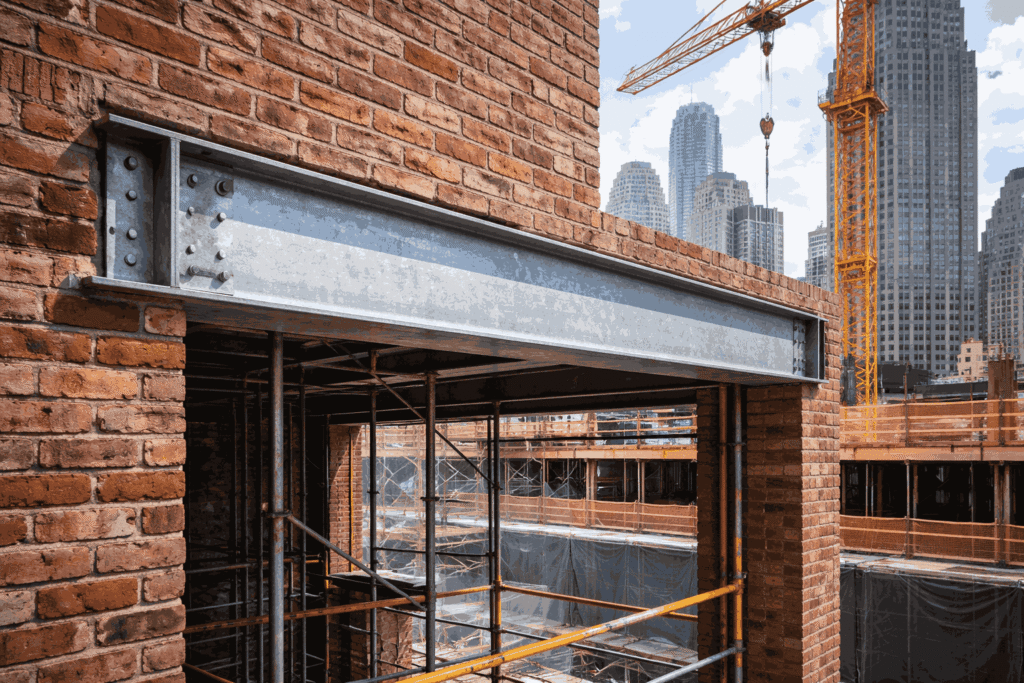
Steel lintels are widely used in NYC construction due to their ability to handle heavy structural loads and accommodate modern building requirements. From high-rise developments and commercial buildings to renovated residential properties, steel lintels offer flexibility in span length and sizing, making them suitable for openings where masonry alone cannot manage the load efficiently.
Advantages of Steel Lintels
- High load-bearing capacity for demanding structural conditions
- Suitable for wider window and door openings
- Flexible sizing options for custom construction needs
- Lighter than stone, reducing installation strain
- Faster installation compared to masonry alternatives
- Lower material cost in most applications
- Compatible with both modern and traditional structures
Disadvantages of Steel Lintels
- Vulnerable to corrosion if not properly galvanized or coated
- Requires routine inspection to monitor rust and wear
- Exposed steel may conflict with historic façade aesthetics
- Thermal movement can cause minor masonry shifts over time
Key Properties of Stone Lintels
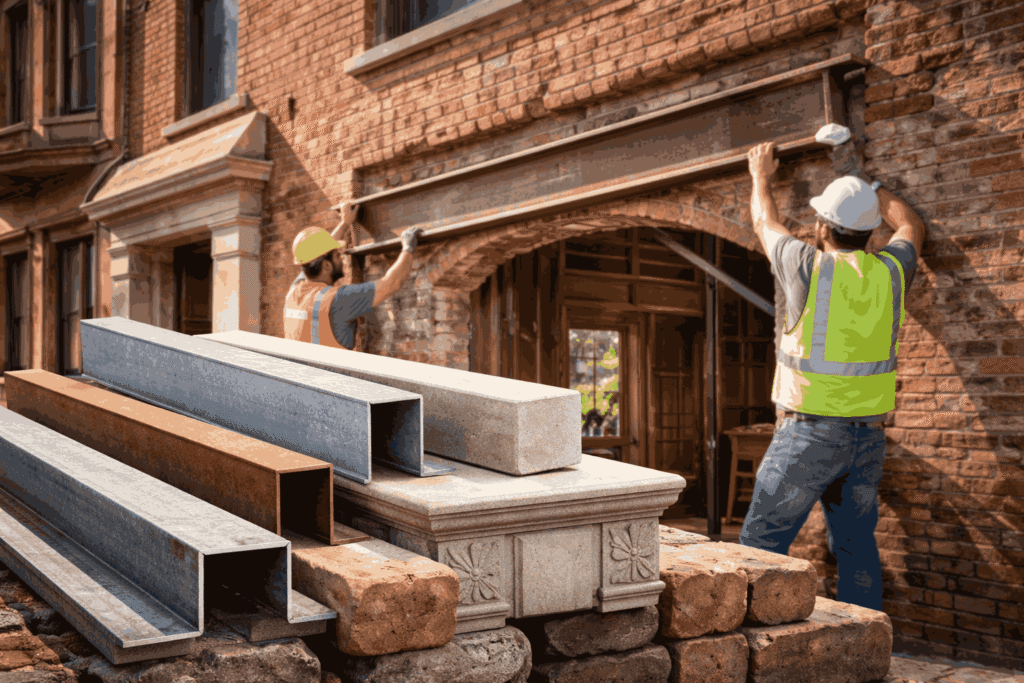
Stone lintels are commonly found in historic NYC buildings, particularly in brownstones and townhouses where architectural continuity and long-term durability are priorities, though lintel failures in older NYC buildings can occur due to age, settlement, and prolonged exposure to environmental stress. Their natural strength and visual consistency with masonry façades make them a preferred choice in pre-war and landmarked properties across Manhattan, the Bronx, and other older neighborhoods.
Advantages of Stone Lintels
- Classic and authentic appearance suited to historic masonry
- Blends naturally with brick and stone façades
- Resistant to rust and corrosion
- Long service life under stable load conditions
- Requires minimal routine maintenance
- Preserves architectural and historic character
Disadvantages of Stone Lintels
- A heavier weight makes installation more complex
- Higher material and labor costs compared to steel
- Limited flexibility for structural adjustments
- More susceptible to cracking under heavy or uneven loads
- Not suitable for wide window or door openings
Load-Bearing Performance: Steel vs Stone Lintels
Load-bearing performance determines how effectively a lintel transfers structural weight from masonry openings into surrounding walls. In NYC buildings, this becomes especially important where wide openings, multi-story loads, aging masonry, and structural stress on lintels in cold weather place continuous strain on structural elements. Steel and stone lintels respond differently to these demands based on their material behavior and structural capacity.
The comparison below highlights how each lintel type performs under typical NYC load conditions:
| Elements | Steel Lintel | Stone Lintel |
|---|---|---|
| Support capability | Very high | Moderate |
| Beam span | Suitable for wide openings | Limited to moderate spans |
| Resilience | High under dynamic loads | Lower under movement stress |
| Crack potential | Low when properly installed | Moderate to high under load |
| Design flexibility | High | Constrained |
Service Life Comparison: Steel vs Stone Lintels
The service life of a lintel is influenced by material behavior, installation quality, and long-term exposure to environmental conditions. In NYC buildings, moisture penetration, temperature fluctuations, and structural loading patterns all play a role in how steel and stone lintels age over time. Proper detailing and load distribution are critical to achieving their expected lifespan.
The table below outlines how steel and stone lintels typically perform in long-term service conditions:
| Features | Steel | Stone |
|---|---|---|
| Oxidation resistance | Mid-level, requires protective coating | Naturally high |
| Weather resistance | Strong when properly protected | Naturally robust |
| Freeze-thaw durability | Performs well under cyclic exposure | Highly stable |
| Typical service life | 30–60+ years | 60–100+ years |
Architectural Impact of Lintels in NYC Homes
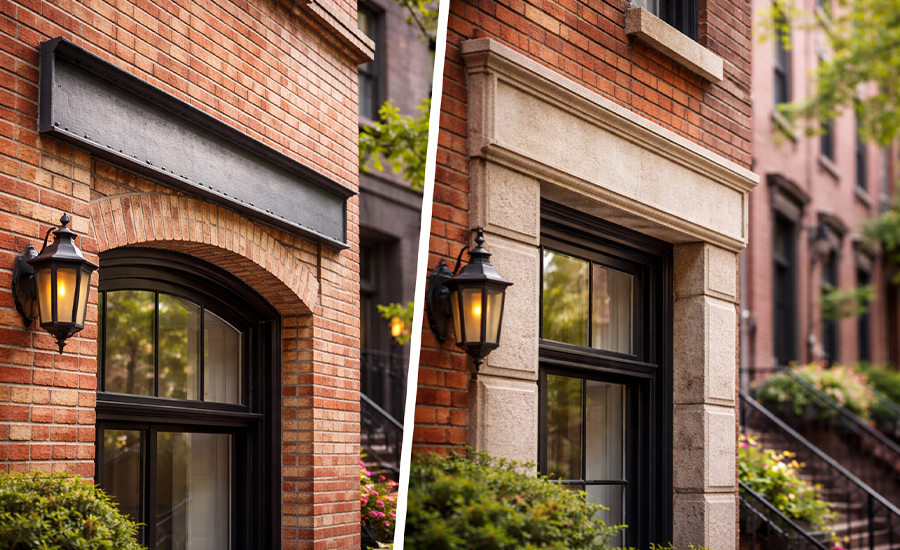
In NYC homes, lintel selection is influenced not only by structural needs but also by architectural character. Steel lintels support modern layouts by accommodating wider spans and concealed installations, while stone lintels reinforce the visual continuity of traditional masonry façades commonly found in historic and pre-war buildings across the city.
Steel Lintels
- Typically concealed behind brick, stone, or stucco finishes
- Well-suited for modern renovations and contemporary designs
- Preferred where visual exposure is not a priority
- Can be hidden using masonry or stone trim for a clean finish
Stone Lintels
- Often left exposed as a visible architectural element
- Commonly used in historic districts and preservation zones
- Visually consistent with brownstones, townhouses, and pre-war buildings
- Frequently required for landmarked properties

Cost Comparison: Steel vs Stone Lintels
Budget plays a major role when selecting lintels for NYC homes, especially when balancing structural needs with long-term expenses. Steel lintels generally offer a lower upfront cost due to simpler fabrication and installation, while stone lintels involve a higher initial investment because of material sourcing, handling, and specialized labor requirements.
The table below outlines common cost-related differences between steel and stone lintels in residential and commercial applications:
| Pricing consideration | Steel Lintel | Stone Lintel |
|---|---|---|
| Product cost | Lower | Higher |
| Installation cost | Lower | Higher |
| Workforce demand | Moderate | Higher |
| Routine care needs | Moderate | Lower |
| Overall financial impact | Cost-effective option | Premium investment |
Choosing the Right Lintel for NYC Homes
Selecting the right lintel depends on balancing structural demands, architectural character, and long-term performance. In NYC homes, building age, opening size, and intended use play a key role in determining whether steel or stone is the more appropriate option for both residential and commercial properties.
Steel Lintels Are Best If:
- Larger window or door openings are required
- Structural strength is the primary concern
- Budget limitations influence material choice
- The lintel will be concealed within masonry
- The project involves modern or mixed-use renovations
Stone Lintels Are Best If:
- The property is historic or landmarked
- Visual consistency with existing masonry is important
- Openings follow traditional proportions
- Long-term durability with minimal upkeep is preferred
- Preserving architectural character is a priority
Maintaining Steel and Stone Lintels in NYC Homes
Ongoing maintenance is essential to preserve the performance of steel and stone lintels in NYC homes, where moisture exposure, temperature variation, and aging masonry place continuous stress on structural elements. Regular inspections help identify early signs of deterioration, including cracks around windows during winter, and reduce the risk of façade damage in both residential and commercial buildings.
Steel Lintel Maintenance
- Inspect periodically for surface rust or coating failure
- Ensure proper drainage above the lintel to prevent moisture buildup
- Reapply protective coatings when exposed steel is visible
- Monitor surrounding masonry for staining or corrosion marks
Stone Lintel Maintenance
- Check for cracks, spalling, or surface separation
- Avoid aggressive pressure washing that can weaken stone
- Maintain flashing and waterproofing to limit moisture intrusion
- Observe for movement caused by settlement or load shifts
Final Verdict
There is no single solution that fits every NYC property when choosing between steel and stone lintels. Steel lintels are better suited for modern renovations where structural strength, wider openings, and cost efficiency are priorities, while stone lintels remain the preferred choice for historic buildings that require architectural continuity and long-term durability. In many cases, combining both materials within a property provides an effective balance between performance and appearance.
Sardar Restoration Corp serves residential and commercial properties across NYC, including The Bronx, Manhattan, Brooklyn, Westchester, and Queens, working as a trusted lintels repair contractor in NYC that property owners rely on. Each repair approach is adapted to local building conditions, material behavior, and seasonal exposure to support reliable, long-term structural performance.
For more information or to discuss your property concerns, contact (+1) 917-355-8556, email sardarrestoration@gmail.com, or visit 2770 Fish Ave, Bronx, NY 10469, United States.
FAQs
What is the primary purpose of a lintel in a home?
The primary purpose of a lintel is to support the weight of masonry above windows and doors and transfer that load safely into the surrounding walls to prevent cracking or structural failure.
Which lintel material is stronger: steel or stone?
Steel lintels offer higher tensile strength and can support wider openings, while stone lintels are strong under vertical loads but perform best in smaller or traditional openings.
Are steel lintels commonly used in NYC homes?
Yes, steel lintels are widely used in NYC homes, particularly in renovations and modern buildings where larger window or door openings are required.
Why do many historic NYC buildings use stone lintels?
Historic NYC buildings use stone lintels to maintain architectural authenticity, as stone matches traditional masonry and is often required in landmarked properties.
Can steel lintels rust in NYC’s climate?
Steel lintels can corrode if left unprotected, but properly galvanized or coated steel performs well in NYC conditions when regularly inspected and maintained.
Do lintels need replacement during window or door renovations?
Lintels should be inspected during window or door renovations, as changes in opening size or load can require reinforcement or replacement to maintain structural safety.
What are common signs that a lintel may be failing?
Common signs include stepped cracks above openings, rust staining on masonry, sagging brickwork, difficulty opening and closing windows and doors, and signs that your window sill needs repair.