
 ChatGPT
 Perplexity
 Google AI
 Claude
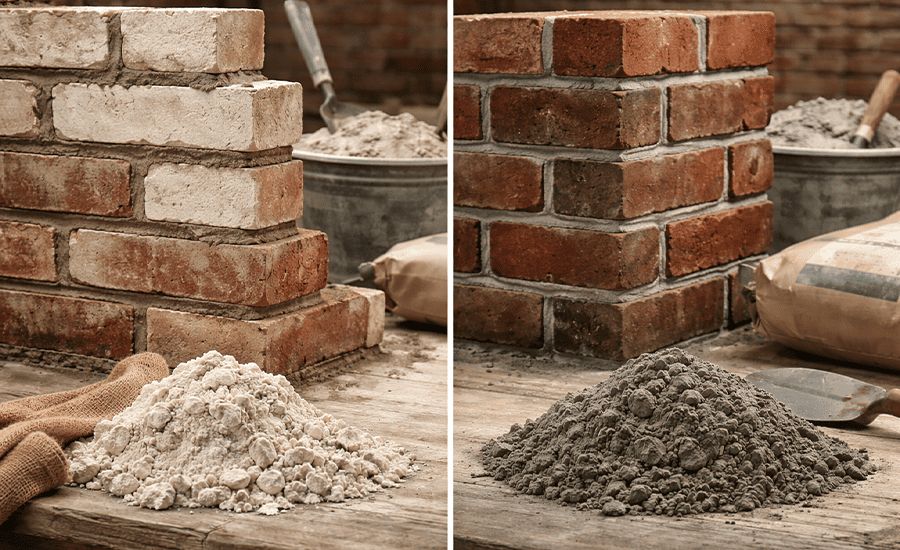
Be it historic or contemporary brickwork, using the appropriate mortar type is really important as it makes your structure stronger, extends its service life, and prevents moisture intrusion into the masonry. Using the wrong mortar can lead to cracking, trapped moisture, brick damage, and costly repairs. Use lime-based mortar for older and historic buildings, and cement-based mortar for modern buildings. Hiring a professional contractor provides you with the best guidelines and uses the correct ratios for structural soundness and stability.
In this blog, we’ll discuss the differences between lime and cement-based mortar, their long-term performance, and a cost comparison.
Introduction To Lime Mortar
Lime mortar is a traditional masonry material made from lime and sand. It has been used for centuries in brick construction. The following are the key characteristics of lime-based mortar:
- It is formulated from non-hydraulic or hydraulic lime
- It sets slowly through carbonation
- It remains flexible and breathable
- It is softer than most bricks
- It is ideal for historic and older buildings
Introduction To Cement Mortar
Cement mortar is a modern masonry material commonly used in contemporary construction. The following are the key characteristics of cement-based mortar:
- It is formulated from Portland cement and sand
- It sets quickly through hydration
- It becomes hard and dense once cured
- It has high compressive strength
- It is designed for modern brick and block construction
Overview: The Load-bearing Capacity Difference
Cement-based mortar is relatively strong and has excellent load-bearing capacity:
| Characteristics | Lime Mortar | Cement Mortar |
|---|---|---|
| Crushing strength | Controlled level | Elevated |
| Flexural resistance | Limited | Elevated |
| Rigidity | Increased | Subdued |
| Damage potential | Barely noticeable | Highly impactful on soft masonry |
| Support capability | Limited | Highly effective |
Which Mortar Has Better Moisture Management Performance?
Let’s have a look at which mortar has the best moisture-repelling properties.
Moisture Advantages of Lime-Based Mortar
- It allows moisture to evaporate naturally
- It reduces the risk of damp walls
- It prevents salt buildup
- It minimizes freeze-thaw damage
- It protects brick faces from spalling
Risks of water ingress of Mortar-Based Mortar
- It traps moisture inside the brick
- It increases internal damp
- It shows up as efflorescence
- It accelerates brick cracking and decay
- It causes long-term structural issues
Cold climate exposure makes moisture control even more critical, which is also explained in can brick pointing prevent frost damage in cold climates?
Which Mortar Stands Out For Its Mortar Durability?
Both types of mortar have high resilience depending on their composition. Let’s have a look at which mortar is durable over time.
Lime mortar durability
- It undergoes natural weathering
- It acts as a buffer layer
- It is easier to repoint
- It extends the brick lifespan
- It is the best for long-term preservation
Cement mortar durability
- It has immediate load-resistance
- It suffers from long-term embrittlement
- Repairs often damage bricks
- It shortens the lifespan of soft masonry
- It offers costly long-term maintenance
Seasonal conditions directly affect mortar longevity, which is discussed further in How does extreme heat impact mortar in brick pointing?
Cost Considerations For Mortar Choice
Here is the cost comparison between lime-based and cement-based mortar. Let’s have a look and determine which is more cost-effective:
| Financial factor | Lime Mortar | Cement Mortar |
|---|---|---|
| Supply cost | Average | Limited |
| Workmanship fee | Increased | Limited |
| Fixing expense | Limited | Increased |
| Longevity value | Increased | Average |
| Wall reconstruction risk | Barely noticeable | Increased |
Factors For Selecting Appropriate Mortar
Have a look at the given table to determine which mortar is best for the following situations:
| Condition | Appropriate mortar |
|---|---|
| Traditional brickwork | Lime mortar |
| Absorbent masonry | Lime mortar |
| Water-compromised masonry | Lime mortar |
| Partial displacement | Cement mortar |
| Strong load demand | Cement mortar |
Final Verdict
In conclusion, lime mortar is best for repairing older brick walls where breathability and flexibility matter, as homeowners demand long-term brick preservation. Homeowners are advised to use high-strength cement-based mortar when repairing or replacing modern masonry.
Sardar Restoration Corp proudly serves every corner of NYC, including the Bronx, Manhattan, Brooklyn, Westchester, and Queens. Our services are designed to meet your specific needs, providing top-quality solutions wherever you are. Check our service areas to see how we can assist you in your location.
Contact us today at (+1) 917-355-8556 or sardarrestoration@gmail.com, or visit us at 2770 Fish Ave, Bronx, NY 10469, United States.
FAQs
Can lime mortar and cement mortar be mixed?
No, it is not recommended to mix lime and cement mortar, as it can cause premature failure of brick structures. If mixing is done, the compatibility of the mortars must be carefully tested.
Does lime mortar need special maintenance compared to cement mortar?
Yes. Lime mortar needs periodic inspection and repointing over time, but it protects bricks by wearing out first, which reduces long-term wall damage.
Is lime mortar weaker than cement?
Yes! Lime Mortar is weaker by design, as it is suitable for historical brickwork. Lime-based mortar protects bricks by being sacrificial, and its strength matches brick hardness.
Which mortar lasts longer?
Lime-based mortar lasts longer and better preserves brick, while cement-based mortar is made for modern masonry.
How do I know if my brick wall has the wrong type of mortar?
Common signs include cracked bricks, flaking faces, trapped damp patches, and mortar that looks harder than the surrounding bricks.
Can cement mortar damage brick walls?
Yes, it does! Cement mortar damages soft, older brickwork by causing bricks to crack and flake, trapping moisture inside and leading to costly, long-term repairs.
Why is breathability crucial in brick walls?
Breathability should be present in the brick walls as it prevents moisture buildup, reduces damp and mold issues, prevents efflorescence, and extends the life of the wall.