
 ChatGPT
 Perplexity
 Google AI
 Claude
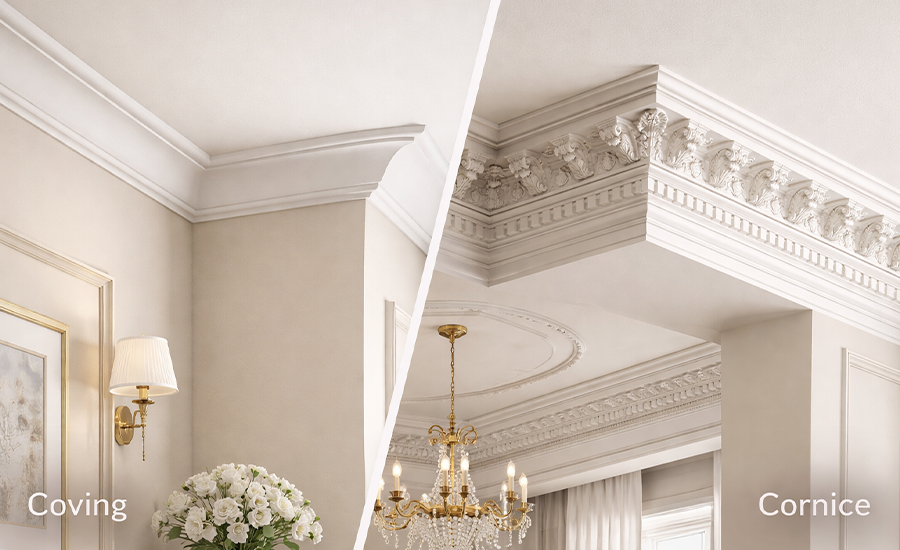
Coving and cornice are decorative moldings used at the junction of walls and ceilings. While both serve a similar purpose, coving features a simple curved design, whereas cornices are more detailed and decorative in appearance.
In residential and commercial interiors, these finishing elements are often confused with each other. However, they differ in design style, installation complexity, cost, and overall visual impact.
This guide explains the key differences between coving and cornice, their uses, materials, installation methods, and which option may be more suitable based on your interior style and budget.
- Ο Coving and cornice are decorative trims installed where the wall meets the ceiling.
- Ο Coving has a simple, curved design and is commonly used in modern interiors.
- Ο Cornices are more detailed and decorative, often used in traditional or classic designs.
- Ο Coving is generally more affordable and easier to install, while cornices require skilled installation and higher costs.
- Ο The choice depends on interior style, budget, and the level of decorative detail required.
Difference Between Coving and Cornice
Coving and cornice are both used at wall-to-ceiling junctions, but they differ in design, complexity, cost, and overall visual impact. The table below highlights the key differences to help you quickly understand which option suits your space.
In broader architectural terms, elements like coving and cornices are often considered part of finishing details, similar to what façade work involves in construction when defining the overall appearance of a building.
| Feature | Coving | Cornice |
|---|---|---|
| Design Style | Simple, smooth, curved | Detailed, decorative, and layered |
| Appearance | Minimal and subtle | Bold and visually prominent |
| Installation | Easier and quicker to install | Requires skilled workmanship |
| Cost | More budget-friendly | Higher cost due to design complexity |
| Materials | PVC, polyurethane, plaster | Plaster, wood, gypsum |
| Best Use | Modern and simple interiors | Traditional and high-end interiors |
| Maintenance | Low maintenance | May require more upkeep due to detailing |
What is Coving?
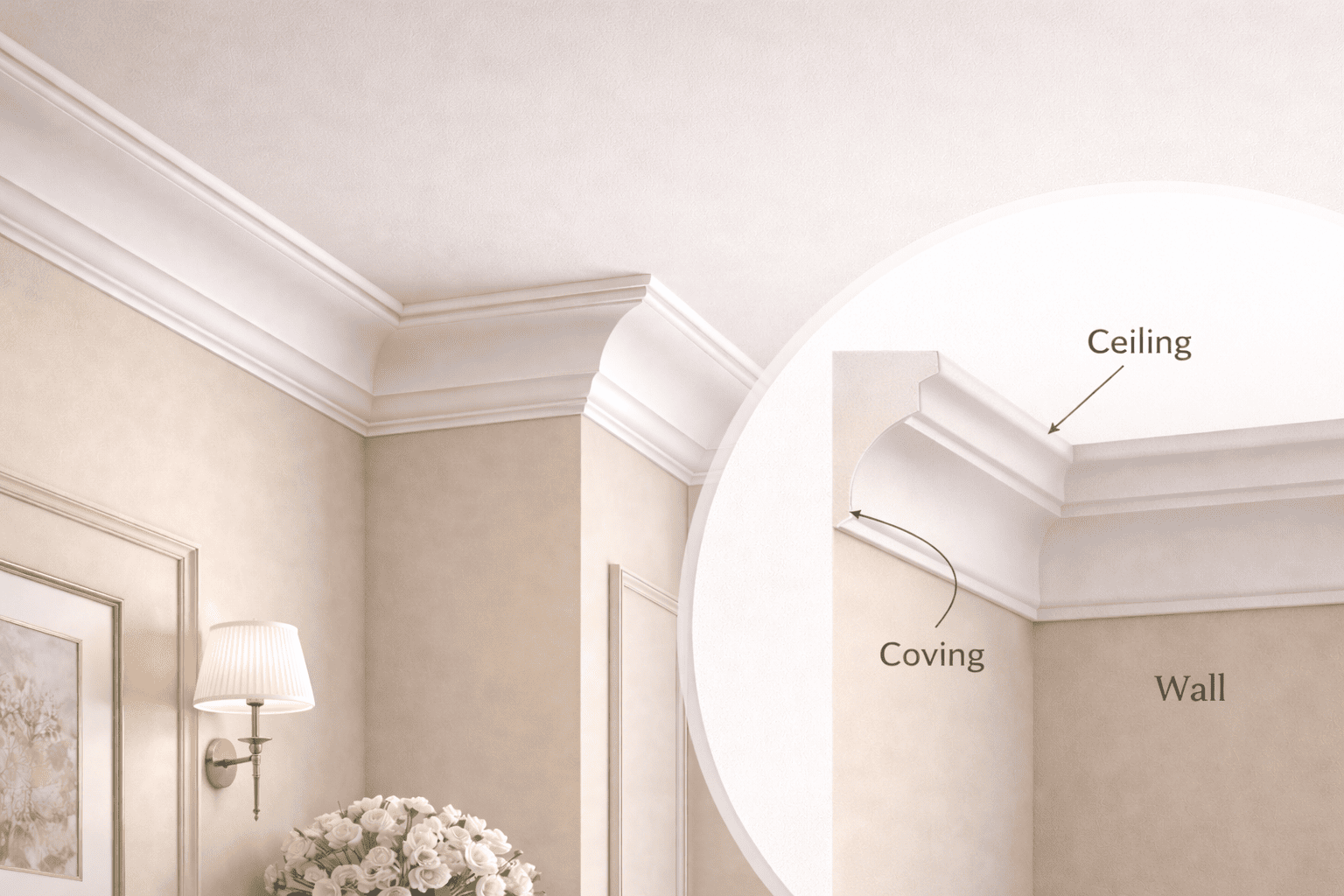
Coving is a simple, rounded molding installed at the junction where the wall meets the ceiling. It creates a smooth transition between the two surfaces and softens the sharp angle typically formed at this joint.
Coving provides a clean and modern look and is commonly used in homes and apartments. It is suitable for areas such as living rooms, bedrooms, and hallways where a subtle finish is preferred.
Key characteristics of coving:
- Smooth, concave curve between wall and ceiling
- Simple and subtle design
- Typically made from plaster, polyurethane, or PVC
- Easy and quick to install
- More affordable than cornices
- Best suited for modern and minimalist interiors
What is Cornice?
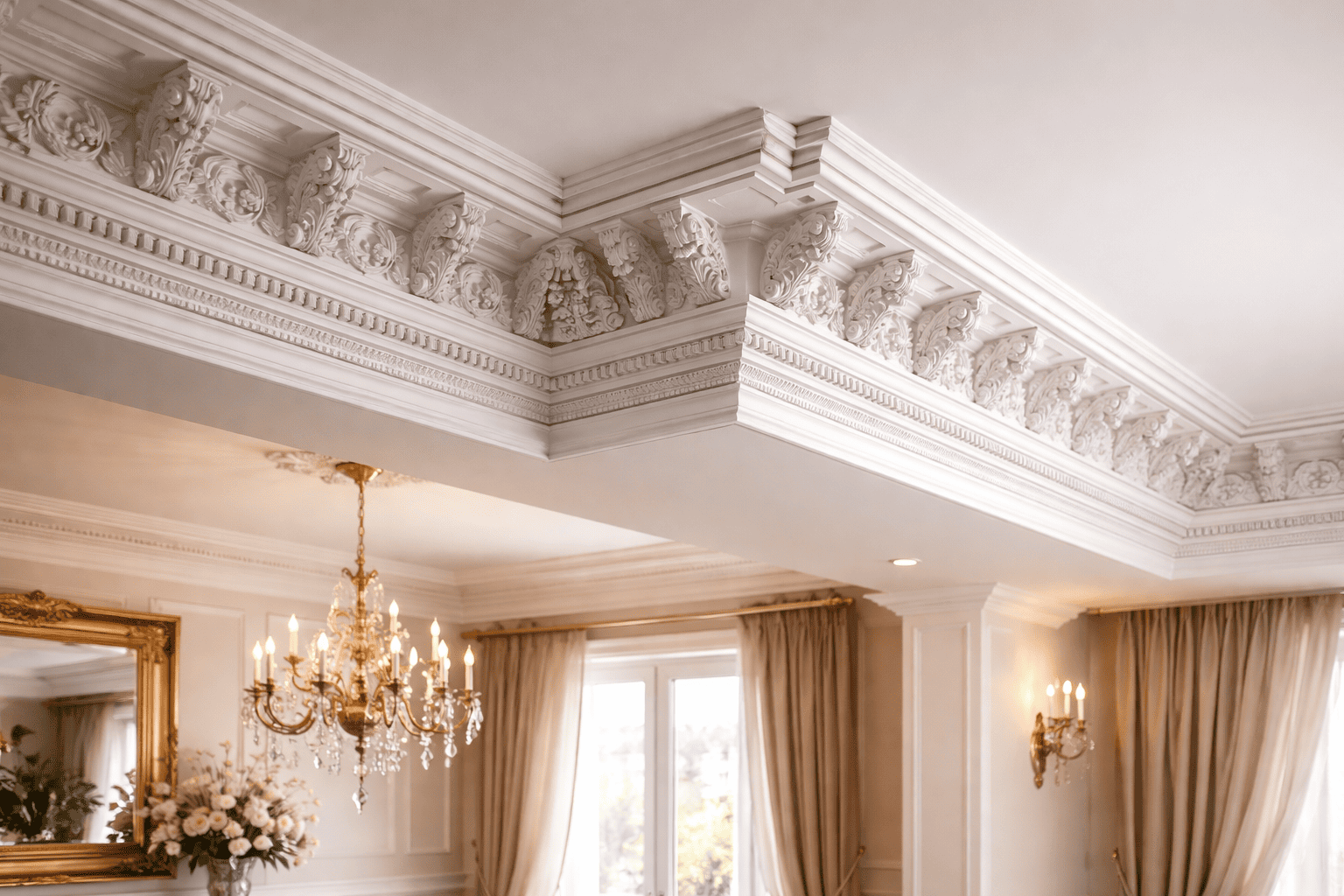
A cornice is a decorative molding installed at the top of a wall along the ceiling edge. Unlike coving, cornices feature more detailed and ornamental designs, often including patterns, layers, or carved elements. Understanding how contractors inspect building cornices can also help identify structural or decorative issues over time.
Cornices are commonly used in traditional and high-end interiors, particularly in historic buildings, luxury homes, and restoration projects where decorative detailing is required.
Key characteristics of cornices:
- Detailed and decorative designs
- Often includes layered or patterned elements
- Larger and more prominent than coving
- Made from plaster, wood, or gypsum
- Enhances architectural appearance
- Requires skilled installation
What Materials Are Used for Coving and Cornices?
Coving and cornices are available in different materials, and the choice depends on budget, durability, and the level of decorative detail required. Each material offers specific benefits based on installation needs and interior style.
| Material | Best For | Key Benefits |
|---|---|---|
| Plaster | Coving & Cornice | Durable with a traditional finish |
| Polyurethane | Coving | Lightweight and easy to install |
| Gypsum | Cornice | Smooth finish with design flexibility |
| PVC | Coving | Cost-effective and moisture-resistant |
| Wood | Cornice | Classic appearance with premium feel |
When Is Coving the Right Choice?
Coving is a suitable option when you want a clean and simple interior finish without heavy decorative detailing. It works well for spaces where a smooth transition between the wall and ceiling is preferred.
- Modern living spaces
- Affordable renovation projects
- Simple interior styles
- Quick home improvement upgrades
- Smaller rooms that benefit from subtle detailing
When Is Cornice the Right Choice?
Cornice is a better choice when the goal is to add strong decorative detail and enhance the architectural character of a space. It is commonly used in interiors where visual impact and design detailing are a priority.
- Luxury home interiors
- Traditional or historic buildings
- Hotel lobbies or large living spaces
- Restoration of heritage structures
- Spaces with high ceilings
Which One Should You Choose?
If you prefer a clean and modern interior, coving is the better choice as it provides a simple and smooth finish. It is also more suitable for budget-friendly projects and smaller spaces where minimal detailing is required.
If your goal is to create a more decorative and traditional look, cornice is the better option. It adds depth and architectural detail, making it ideal for larger rooms, high ceilings, and premium interiors.
For most modern homes, coving works well due to its simplicity and ease of installation. For classic or high-end spaces, cornices offer a stronger visual impact and a more refined appearance.
Key Advantages of Coving and Cornice
Coving and cornices both enhance the wall-to-ceiling junction by improving the overall finish of interior spaces. While both serve a decorative purpose, their advantages differ based on design complexity, installation requirements, and maintenance needs.
Coving is generally easier to maintain and install, making it suitable for simpler projects. Cornices, on the other hand, offer stronger visual detail and are better suited for interiors where decorative impact is a priority. However, they may require more maintenance over time, especially in environments where weather exposure can lead to issues, such as how freeze-thaw cycles affect building cornices.
| Aspect | Coving | Cornice |
|---|---|---|
| Visual finish | Clean and smooth appearance | Detailed and decorative look |
| Installation | Easier and quicker to install | Requires skilled workmanship |
| Cost efficiency | More budget-friendly | Higher due to design complexity |
| Maintenance | Low maintenance | May require periodic upkeep |
| Use suitability | Suitable for simple interiors | Suitable for detailed interiors |
How Much Do Coving and Cornices Cost?
The cost of installing coving or cornices depends on the material used, design complexity, and installation requirements. Based on recent estimates, the typical cost ranges from $550 to $4,200 per room for professional installation.
| Cost Factor | Coving | Cornice |
|---|---|---|
| Material cost | Low to moderate | Medium to high |
| Installation cost | More affordable | Higher due to skilled labor |
| Design complexity | Simple | Detailed and decorative |
| Maintenance cost | Lower overall | Moderate over time |
Cornices generally cost more due to their detailed design and the need for skilled installation.
Conclusion
Coving and cornices are both used to enhance the wall-to-ceiling junction, but they differ in design detail, installation complexity, and overall visual impact.
If you want a simple and modern finish, coving is the more practical option. If you prefer a more detailed and classic look, a cornice is better suited for your space.
Choosing the right option depends on your interior style, budget, and the level of decorative detail you want to achieve.
Sardar Restoration Corp supports residential and commercial properties across NYC, including the Bronx, Manhattan, Brooklyn, Westchester, and Queens. Regular exterior maintenance, including the importance of timely façade repairs in NYC, also plays a key role in preserving structural integrity and long-term property value. For property assessments, you can reach our team at (+1) 917-355-8556 or email sardarrestoration@gmail.com.
FAQs
Can coving and cornice be used in the same room?
Yes, coving and cornice can be used in the same room if the design is balanced. However, most homeowners choose one option to maintain a consistent and cohesive interior style. Using both is more suitable for decorative or high-end interiors.
Which is better for modern homes: coving or cornice?
Coving is generally better for modern homes because it offers a clean and simple finish. Cornices are more suitable for traditional or classic interiors where detailed design is preferred.
Does installing coving or cornice increase property value?
Yes, both coving and cornices can improve the overall appearance of an interior, which can contribute to higher property value. Well-finished interiors are often more appealing to buyers.
Can coving hide cracks between walls and ceilings?
Coving can cover minor cracks at the wall-to-ceiling joint, but it should not be used as a permanent fix. It is recommended to repair the damaged area before installation to prevent further issues.
What is the main difference between coving and cornice?
The main difference is in design and detail. Coving has a simple curved shape, while cornices are more decorative with detailed patterns and layers.
Is coving cheaper than cornice?
Yes, coving is usually more affordable because it has a simpler design and requires less complex installation compared to cornices.
Which lasts longer: coving or cornice?
Both can last for many years if installed correctly. Durability mainly depends on the material used and the quality of installation.
Can coving and cornices be painted?
Yes, both coving and cornices can be painted to match or enhance the interior design of a room.