
 ChatGPT
 Perplexity
 Google AI
 Claude
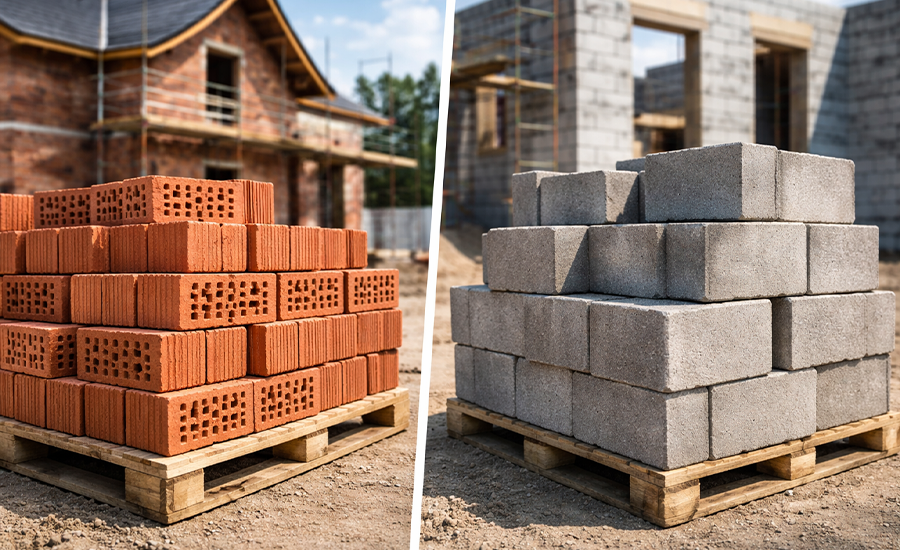
When comparing brick vs concrete block, there is no single “better” material, as each serves a different structural purpose in masonry construction.
- Brick is used for comfort, insulation, and visible exterior walls
- Concrete block is used for structural load, foundations, and taller buildings
- Brick works best in low-rise construction
- Concrete block works best in reinforced or high-load structures
In simple terms, choose brick for comfort and appearance, while concrete block suits structural strength and budget efficiency.
Key Differences Between Bricks and Concrete Blocks
Although both materials appear similar, the right choice depends on structural load requirements, construction speed, thermal comfort, and overall construction cost.
The table below summarizes the practical differences between brick and concrete block in construction.
| Property | Bricks | Concrete Blocks |
|---|---|---|
| Main material | Clay / shale | Cement, sand, aggregates |
| Typical size | Smaller units | Larger units |
| Structural strength | Suitable for low-rise load-bearing | Suitable for higher structural loads |
| Insulation | Higher thermal and sound insulation | Moderate insulation |
| Construction speed | Slower installation | Faster installation |
| Cost | Higher labor cost | Lower labor cost |
| Durability | Very long lifespan (100+ years possible) | Long lifespan (several decades) |
| Appearance | Traditional, decorative finish | Plain, modern finish |
| Maintenance | Minimal maintenance | Often requires plaster or finish |
| Best use | Homes, facades, boundary walls | Multi-story buildings, commercial structures |
What Are Bricks in Construction?
In brick vs concrete block construction, bricks are small clay masonry units fired in a kiln, giving them strength, durability, and natural weather resistance. This process creates a dense structure that improves durability and resistance to weathering, especially in urban areas where homes are affected by long-term moisture damage.
Because of their density and thermal mass, brick walls regulate indoor temperature well and reduce outside noise. They are commonly used in houses, facades, boundary walls, chimneys, and architectural detailing where both performance and appearance matter, particularly when selecting the right masonry joint profile.
What Are Concrete Blocks in Construction?
In brick vs concrete block construction, concrete blocks (CMU) are larger masonry units made from cement, sand, and aggregates, formed in molds and cured for structural strength.
Due to their larger size and structural capacity, concrete blocks are widely used in foundations, basements, retaining walls, and multi-story buildings. They can also be reinforced with steel bars and grout to handle heavy loads, depending on the type of concrete block wall system used in the structure.
Concrete block construction is typically chosen for large projects where structural strength and installation speed matter more than decorative appearance, which is why selecting a qualified masonry contractor is important for structural performance.
Which Material Supports Structural Load Better in Construction?
Structural strength in brick vs concrete block construction depends on how the wall distributes weight over time, not just the strength of a single unit.
Brick masonry creates dense, bonded walls where loads remain stable and predictable. This makes brick suitable for houses and low-rise load-bearing buildings where structural demand does not change significantly.
Concrete block masonry works as a reinforced structural system. Hollow cores allow steel reinforcement and grout filling, enabling walls to resist bending pressure, heavy vertical loads, and future expansion.
| Structural Factor | Bricks | Concrete Blocks |
|---|---|---|
| Load bearing capacity | Good for low-rise structures | Suitable for high structural loads |
| Reinforcement support | Not typically reinforced | Can be steel reinforced |
| Suitable building height | Houses and small buildings | Multi-story buildings |
| Crack resistance under heavy load | Moderate | Higher when reinforced |
| Foundation suitability | Limited use | Commonly used |
| Structural flexibility | Low | High |
Concrete blocks are preferred for high structural load, foundations, and vertical expansion, while bricks remain suitable for stable, low-rise residential load-bearing walls.
Which Material Provides Better Insulation and Indoor Comfort?
Thermal performance affects how well a building stays cool in summer and warm in winter, while acoustic performance determines how much outside noise enters the interior.
Brick walls naturally store and slowly release heat due to their higher thermal mass. This helps stabilize indoor temperature throughout the day and reduces sudden temperature changes. The dense structure also limits sound transmission, making interiors quieter in busy urban areas.
Concrete block walls transfer heat more quickly unless additional insulation is installed. However, many modern constructions add insulation layers within or over the blocks, allowing them to meet energy efficiency requirements when properly designed.
| Performance Factor | Bricks | Concrete Blocks |
|---|---|---|
| Thermal mass | High | Moderate |
| Indoor temperature stability | More stable | Depends on added insulation |
| Sound insulation | Better natural noise reduction | Moderate noise reduction |
| Energy efficiency without insulation | Higher | Lower |
| Energy efficiency with insulation | Similar | Similar |
Bricks provide better natural insulation and indoor comfort without added layers, while concrete blocks reach similar performance only after additional insulation is installed.
Cost Comparison: Material, Labor, and Long-Term Value
The cost of brick vs concrete block construction depends on installation time, labor effort, finishing requirements, and long-term maintenance, not just unit price.
Brick construction requires more labor because smaller units need more mortar joints and alignment. Installation takes longer, but exposed brick often does not require plaster or finishing, reducing future maintenance costs.
Concrete blocks install faster due to their larger size, reducing labor time and overall project cost. However, block walls usually require plaster or exterior finishing after construction.
| Cost Factor | Bricks | Concrete Blocks |
|---|---|---|
| Material cost per unit | Higher | Lower |
| Labor cost | Higher due to slower laying | Lower due to faster installation |
| Construction time | Longer | Shorter |
| Finishing requirement | Often not required | Usually required |
| Initial project cost | Moderate to high | Lower for large projects |
| Long-term maintenance | Low | Moderate |
Bricks can be cost-effective for smaller residential projects, while concrete blocks are usually more economical for large or multi-story construction.
Durability and Lifespan: Which Material Lasts Longer?
Durability depends on resistance to moisture, temperature changes, cracking, and long-term structural stability.
Bricks are known for their long lifespan and resistance to weather exposure. Properly installed brick masonry can last for more than a century with minimal structural deterioration. Their dense composition makes them resistant to fire, pests, and gradual environmental wear.
Concrete blocks are also highly durable, especially when reinforced and properly sealed. However, because they are more porous than fired clay bricks, moisture management and surface protection become important. When maintained correctly, reinforced block structures can also last several decades without major structural issues.
| Durability Factor | Bricks | Concrete Blocks |
|---|---|---|
| Average lifespan | 100+ years possible | Several decades |
| Fire resistance | Excellent | Excellent |
| Moisture resistance | High | Moderate (needs sealing) |
| Weather resistance | Strong against freeze-thaw | Good when sealed |
| Structural longevity | High in low-rise buildings | High in reinforced systems |
| Maintenance frequency | Low | Moderate |
Bricks generally last longer with lower maintenance, while concrete blocks remain durable when properly sealed and reinforced.
Which Material Builds Faster and Requires Less Labor?
Project timeline is a critical factor in modern construction, especially for commercial and multi-story developments.
Brick installation requires placing many smaller units, which increases labor time and alignment precision. This results in slower construction but allows detailed craftsmanship and decorative finishes.
Concrete blocks significantly reduce installation time because of their larger size. Fewer units are needed to cover the same wall area, and labor productivity improves. This makes block construction more efficient for large-scale projects where speed directly impacts overall cost.
| Construction Factor | Bricks | Concrete Blocks |
|---|---|---|
| Unit size | Smaller | Larger |
| Installation speed | Slower | Faster |
| Labor intensity | Higher | Lower |
| Project timeline | Longer | Shorter |
| Best suited for | Detail-focused builds | Large-scale construction |
Concrete blocks build faster and require less labor, while bricks take longer but allow more detailed finishing.
Which Material Looks Better and Offers More Design Flexibility?
In brick vs concrete block construction, appearance depends on surface finish, texture, and whether the wall is exposed or covered. The surface finish, texture, and architectural style all depend on the masonry unit used.
Bricks offer a natural finished appearance with color variations and patterns that remain visible after construction. Because they do not usually require plastering, they are widely used where architectural detail and traditional aesthetics are important.
Concrete blocks prioritize structural uniformity rather than appearance. Their surface is typically plain and intended to be covered with plaster, paint, or external finishes. This allows designers to achieve a smooth modern look, but the final appearance depends on added finishing materials rather than the block itself.
| Design Factor | Bricks | Concrete Blocks |
|---|---|---|
| Natural finished look | Yes | No |
| Surface texture | Varied and decorative | Plain and uniform |
| Need for plaster or cladding | Usually not required | Usually required |
| Architectural style suitability | Traditional and detailed | Modern and minimal |
| Pattern flexibility | High | Limited without finishing |
| Final appearance control | From masonry itself | From applied finishes |
Bricks look better when the masonry is left exposed, while concrete blocks are better suited for plastered or modern-finished exteriors.
When Is Brick the Better Choice?
Brick is the better choice for houses and low-rise buildings where comfort, natural insulation, and exposed architectural appearance are priorities. It regulates indoor temperature, reduces noise, and requires minimal finishing or repainting over time.
Brick Is More Suitable When:
- The building is a house or a low-rise residential structure
- Natural insulation and indoor comfort are important
- A traditional or exposed masonry appearance is desired
- Minimal finishing or cladding is preferred
- Long lifespan with low maintenance is a priority
- The structure does not require heavy reinforced load support
In these cases, brick construction offers comfort, durability, and low maintenance, often reducing the need for major structural masonry repairs over time.

When Are Concrete Blocks the Better Choice?
Concrete blocks are the better choice when high structural load, faster construction, and budget efficiency are priorities, especially in multi-story or reinforced buildings.
Because they can be steel-reinforced and installed quickly, concrete blocks are commonly used in commercial buildings, retaining walls, and large-scale projects.
Concrete Blocks Are More Suitable When:
- The building has multiple floors or high structural loads
- Faster construction completion is required
- Labor efficiency is important for the project budget
- The walls will be plastered or externally finished
- Reinforcement with steel is required
- The project is commercial, industrial, or large-scale residential
In these cases, concrete blocks provide strength, speed, and structural scalability.
How to Choose Between Brick and Concrete Block
Both materials are durable and reliable, but the correct choice depends on whether the building prioritizes structural capacity or living comfort.
Bricks prioritize indoor comfort, appearance, and long-term residential performance. They suit projects where the wall is part of the finished architecture and the structure remains within normal load limits.
Concrete blocks prioritize structural flexibility and construction efficiency. They suit buildings that require reinforcement, faster completion, or the possibility of future vertical expansion.
Quick Decision Guide
- Choose brick for houses, facades, boundary walls, and comfort-focused living spaces
- Choose concrete block for foundations and multi-story or commercial buildings
- Choose brick when natural insulation and low maintenance matter
- Choose a concrete block when structural load and project speed matter
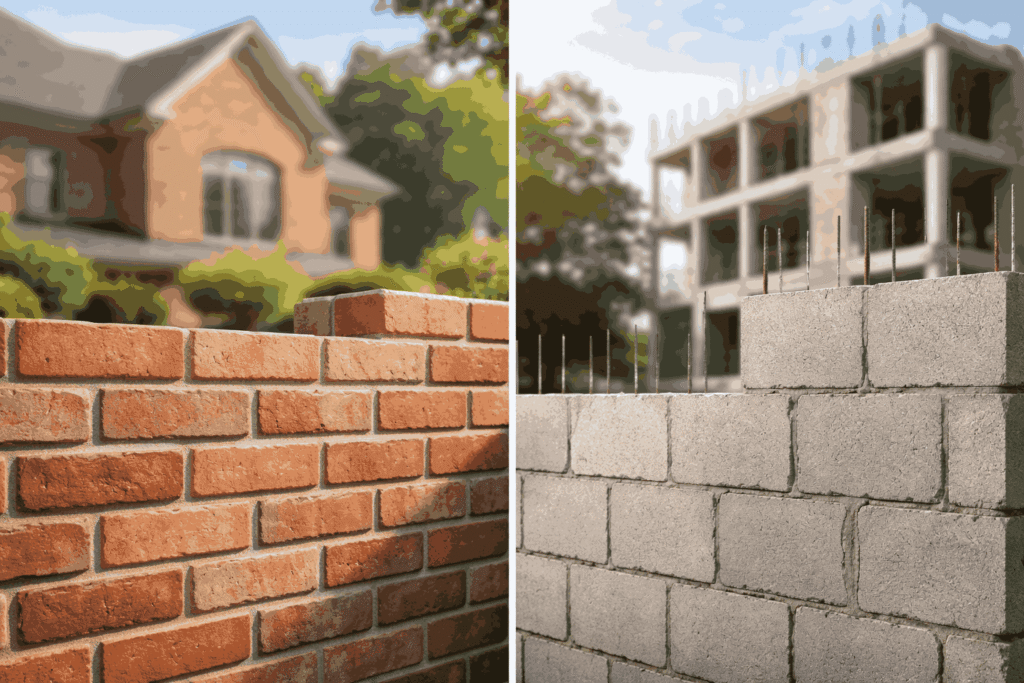
In simple terms, bricks suit comfort-focused residential construction, while concrete blocks are better for structural load, height, and speed-driven projects.
Which Material Performs Better in NYC Climate Conditions?
In cities like New York, buildings face freeze-thaw cycles, moisture exposure, and temperature fluctuations throughout the year, so material performance depends on how well it handles these environmental stresses.
Bricks perform strongly in freeze-thaw conditions due to their dense structure and long history of use in urban environments. Proper mortar selection and periodic joint maintenance help brick walls remain stable for decades.
Concrete blocks can also perform well in the NYC climate when properly sealed and reinforced because blocks are more porous; proper moisture protection and finishing become essential to prevent long-term deterioration.
| Climate Factor | Bricks | Concrete Blocks |
|---|---|---|
| Freeze-thaw resistance | Strong | Good when sealed |
| Moisture absorption | Lower | Higher without sealing |
| Exterior exposure performance | Proven long-term use | Requires finishing protection |
| Suitability for urban density | High | High |
In dense urban settings such as The Bronx, Manhattan, Brooklyn, Queens, and Westchester, both materials perform well when properly installed. Brick provides more dependable long-term exterior durability, while concrete blocks perform best when properly sealed and reinforced for structural loads.
Professional Guidance for Choosing the Right Masonry Material
Selecting between brick and concrete blocks is not just a material choice; it is a structural planning decision. Building height, load requirements, insulation goals, and finishing methods must be evaluated together before making a final selection.
A professional contractor evaluates soil conditions, structural demands, and local building codes to determine the most suitable masonry system. Installation quality, reinforcement planning, and moisture control directly influence long-term stability and safety.
Sardar Restoration Corp serves residential and commercial properties across NYC, including The Bronx, Manhattan, Brooklyn, Westchester, and Queens. Each project is assessed based on load requirements, exposure conditions, and intended building use to ensure dependable long-term performance.
For masonry consultation, call (+1) 917-355-8556, email sardarrestoration@gmail.com, or visit 2770 Fish Ave, Bronx, NY 10469, United States.
FAQs
Which is stronger, a brick or a concrete block?
Concrete blocks handle higher structural loads, especially when reinforced. Bricks remain reliable for low-rise load-bearing walls.
Which material is cheaper to build with?
Concrete blocks usually cost less overall because installation is faster and labor requirements are lower.
Do brick houses last longer than block houses?
Brick structures can last over 100 years with minimal maintenance. Reinforced concrete block buildings also last decades when properly sealed and maintained.
Which material provides better insulation?
Bricks naturally provide better thermal and sound insulation. Concrete blocks reach similar performance when insulation layers are added.
Are concrete blocks safe for residential homes?
Yes. Concrete blocks are widely used in residential construction, especially for foundations and multi-story buildings.
Do brick walls require plastering?
No. Bricks often remain exposed as a finished surface, while concrete block walls usually require plaster or exterior finishing.
Are brick walls more resistant to weather damage?
Yes. Fired clay bricks naturally resist moisture and temperature changes better, while concrete blocks require sealing for similar protection.
Can concrete blocks support additional floors later?
Yes. Reinforced concrete block walls can handle vertical expansion, which makes them suitable for future building extensions.