
 ChatGPT
 Perplexity
 Google AI
 Claude
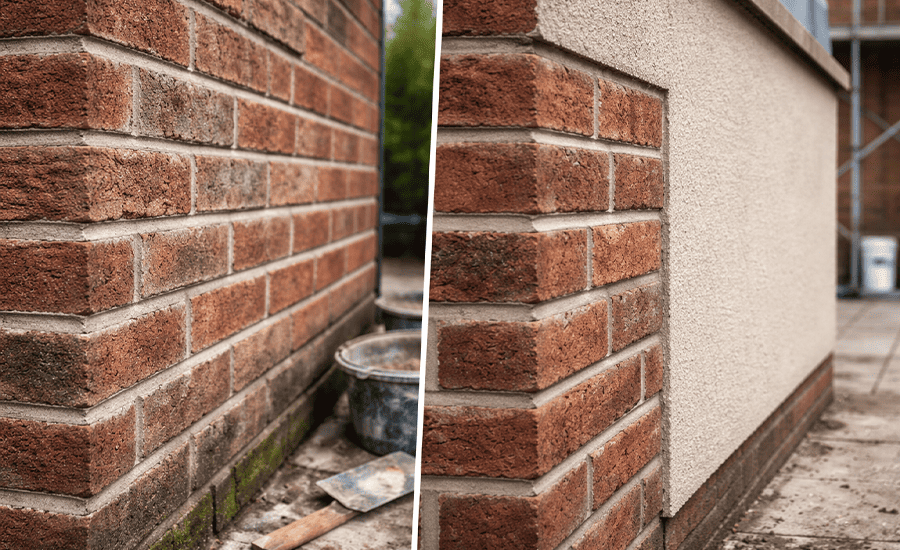
In masonry repairs and restoration, two methods are essential to keep your masonry intact. One is repointing, which involves filling mortar into the brick joints, while the other is Rendering, which helps protect walls and improve appearance. They differ significantly in durability, purpose, maintenance needs, and lifespan. Attention to detail is the most crucial element when opting for these methods, as well as using appropriate materials and complying with local safety standards.
In this blog, we’ll explore the service life of Repointing and rendering services, their cost comparison, and when to use them.
Purpose of Repointing In Masonry
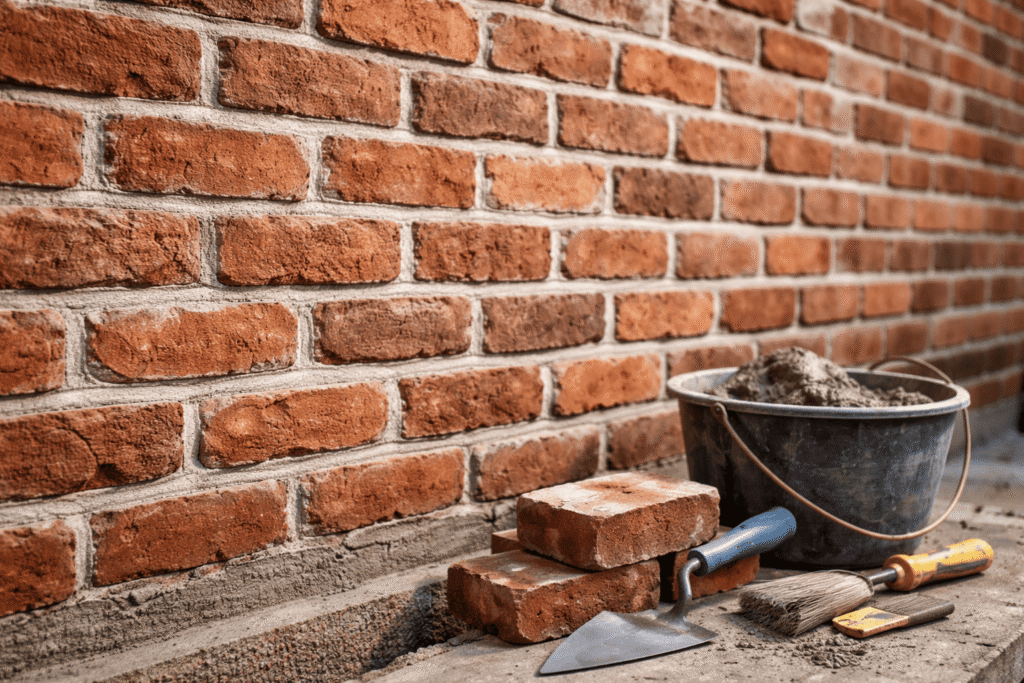
Repointing involves removing damaged or deteriorated mortar from brick or stone joints and replacing it with fresh, compatible mortar.
Functional highlights of Repointing
- It repairs and mends only the mortar joints.
- It strengthens the wall structure.
- It preserves the original appearance.
- It improves breathability and moisture control.
Construction materials involved
- Lime-based mortar is used for historic buildings.
- Cement-based mortar is used for modern construction.
Longevity of Repointing Work
- 40-60 years in standard conditions.
- 60-100 years in heritage buildings using lime mortar.
If you are comparing structural repair options, you may also find it helpful to read Brick repair vs Brick replacement: which is more worth it? to understand when joints can be repaired versus full masonry replacement.
Purpose of Rendering In Building Protection
Rendering is the application of a protective coating over the entire masonry surface, creating a smooth or textured finish.
Functional highlights of Rendering
- It covers brick or stone completely
- It offers a visually striking appearance
- It offers surface-level weather protection
- It can hide surface defects
Popular Rendering finishes
- Cement render
- Lime render
- Acrylic/polymer Render
Longevity of rendering work
- The Cement render may have a service life of 20-30 years.
- The Lime render may have a service life of 25-40 years.
- The acrylic render may have a service life of 15-25 years.
For surface-level protection methods and moisture control alternatives, see Brick pointing vs waterproofing: what protects better?
Comparative Durability Assessment Between Repointing & Rendering
Have a look at the structural strength and durability of the Repointing and Rendering:
| Notable Qualities | Repointing | Rendering |
|---|---|---|
| Expected service life | 40–100 years | 15–40 years |
| Masonry reinforcement | Extensive | Controlled |
| Wall permeance | Optimal | Material-dependent |
| Damp-related risk | Negligible | Considerable |
| Surface failure risk | Low-impact | Extensive |
| Service demand | Minor | Medium to significant |
Longevity Advantages of Repointing
Here are several benefits of the service life of Repointing:
Structural integrity improvements
- It bonds masonry units securely.
- It allows natural wall movement.
- It cuts the long-term structural stress.
Damp prevention capabilities
- It allows walls to breathe.
- It stops the trapping of moisture.
- It reduces damp and mold risks.
Long-term upkeep Benefits
- Localized repairs only.
- No surface peeling or delamination.
- Long intervals between repairs.
Why Rendering Deteriorates Faster?
Rendering tends to deteriorate early, so repointing is needed, as it is just a surface-level coating. The following are the problems that can be faced in Rendering:
Typical Rendering problems
- Surface cracking from thermal movement.
- Water penetration behind the Render.
- Peeling, bubbling, or discoloration.
Upkeep difficulties
- It requires repainting every 8–15 years.
- Cracks need frequent sealing.
- Full re-rendering may be necessary over time.
Cold-weather expansion and moisture penetration risks are covered in detail in Can brick pointing prevent frost damage in cold climates?
When Should You Opt For Repointing?
Repointing is appropriate when:
- Mortar joints are cracked.
- Structural integrity is a priority.
- You want the longest-lasting solution.
- The building is historic or traditional.
Seasonal safety considerations for masonry work are explained further in Is repointing bricks safe in cold weather?
When Should You Opt For Rendering?
Always render your masonry after repointing. Choose the rendering service wisely, when
- The masonry surface is uneven or mismatched.
- A modern, uniform look is desired.
- Repointing has already been completed.
- You accept regular maintenance.
Conclusion
As the final verdict, Repointing is the winner for longevity. Repointing involves repairs that may last 20-40 years, improves structural soundness, and doesn’t require maintenance. So, if you’re looking for a long-term solution, make sure to opt for repointing as it is the superior and longer-lasting choice.
Sardar Restoration Corp proudly serves every corner of NYC, including the Bronx, Manhattan, Brooklyn, Westchester, and Queens. Our services are designed to meet your specific needs, providing top-quality solutions wherever you are. Check our service areas to see how we can assist you in your location.
Contact us today at (+1) 917-355-8556 or sardarrestoration@gmail.com, or visit us at 2770 Fish Ave, Bronx, NY 10469, United States.
FAQs
Can rendering replace Repointing?
No! Rendering is very different from Repointing, as it does not repair damaged mortar joints but instead hides structural and architectural defects.
Which is more expensive: repointing or rendering?
Repointing is usually more cost-effective long term because it focuses only on damaged joints. Rendering may appear cheaper initially but often requires ongoing maintenance and repainting.
Does Repointing prevent dampness?
Yes! Repointing involves properly sealing mortar joints with breathable mortar to prevent moisture intrusion.
How often does Render need maintenance?
Rendering surfaces should be maintained every 5-10 years for inspections and repairs.
Does rendering trap moisture inside brick walls?
Yes, certain rendering materials can trap moisture if they are not breathable. This trapped moisture may lead to damp issues and long-term masonry damage.
Is lime mortar more durable?
Yes! Lime-based mortar is more durable than cement-based mortar, especially in older buildings, helping preserve the structural integrity of historic construction for decades.
How do I know if my building needs repointing instead of rendering?
If mortar joints are cracked, eroded, or falling out, repointing is necessary. Rendering should only be considered after joint repairs are completed.
Can rendering hide structural problems in masonry?
Rendering may conceal surface cracks or defects, but it does not fix underlying structural issues. These hidden problems often reappear as cracks or peeling over time.